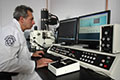
With our strengths in both engineering and research & development, Richter Precision provides coating, material, and failure analysis for commercial projects. We operate a high-tech thin film and metallurgical laboratory to characterize the mechanical, physical, and elemental properties of thin films and materials. As a pioneering company in CVD and PVD coating compositions and process technologies, we have an extensive knowledge base and an arsenal of tools for metallographic and metallurgic analysis and inspection for both routine and highly specialized applications.
Our laboratory houses a range of sophisticated instruments we use in our analytics. Using a scanning electron microscope (SEM), we obtain high-resolution digital images at magnifications of up to 100,000x for qualitative elemental analysis and examination of the topography of a sample’s surface. To derive the mechanical properties of soft, hard, brittle, or ductile materials, we use a high-precision CSM nano-indentation tester to calculate hardness, elastic modulus, etc., of thin films, coatings, and substrates. With a dynamic scratch adhesion tester equipped with an acoustic emission detector and image capture and measurement system, we quantify the adhesive properties of different film/substrate combinations and determine the load at which the coating will start to fail. We also have a range of instruments to measure tribological performance and thin film thickness.
What sets our services above the rest is the group of qualified people we have operating this technology. They possess impressive qualifications and are known as the best and brightest in the industry. Our results and reporting are extraordinarily reliable, accurate, and timely, and we work with some of the most highly respected universities and organizations around the globe. Contact us directly for more detailed information about our laboratory services for research & development and quality assurance.
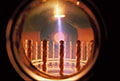
As one of the original PVD coating service providers in North America, Richter Precision pushes the boundaries of this versatile coating technology. We understand the challenges of optimizing tool, component, and product quality and have developed a family of PVD coatings that set the industry benchmark for performance. In our state-of-the-art facility, we leverage the most up-to-date PVD deposition methods, including cathodic arc, pulsed arc, filtered arc, ion beam plating, reactive sputtering, magnetron sputtering, HIPIMS, and more.
Combining our high-performance coatings with the appropriate application technology, we produce a powerful bond between the coating layer and substrate and targeted physical, structural, and tribological surface qualities. We coat an extensive range of substrates, and our coatings exhibit high adhesion and wear resistance while delivering microhardness in the 1,500 to 8,000 HV range.
Our groundbreaking Titankote™ coating compositions satisfy the needs for most metalworking, molding, and casting processes. For the past 40 years, these coatings have helped customers make measurable process improvements. One of our particular areas of expertise is our distinctive Titankote™ amorphous carbon coatings, characterized by their combination of a low coefficient of friction and high micro-hardness. We offer DLC phase compositions with the broadest possible range of selectable mechanical and physical properties to optimize effectiveness in challenging tribological and wear applications.
For highly polished molds, tools, and components, our Replikote™ coating dramatically reduces macro-particle inclusions to improve part release, material flow, and abrasion resistance. We offer biocompatible Medikote™ PVD coating that features excellent micro-hardness, lubricity, and adhesion characteristics, TiFusion™ for severe duty applications, and highly durable Richkote™ for a smooth, bright decorative finish in a broad array of colors.
With our advanced PVD films and highly engineered processes, we help customers dramatically improve the efficiency and profitability of their tools and manufacturing processes. For more information about our PVD coatings and application technologies, contact us directly.

At Richter Precision, we provide the highest quality vacuum heat treating service available. Our vacuum heat treating involves thermal processing in heated chambers evacuated to partial pressures, positive pressure quenching, and controlled cooling. We substitute vacuum for the more commonly used protective gas atmosphere during part or all the heat treatment to create oxidation-free surfaces, improve mechanical properties, and minimize workpiece distortion or deformation. Vacuum heat-treated parts are not contaminated by high-temperature reactions, so they are free from discoloration and exhibit a bright, scale-free surface. With our process uniformity, pieces also feature remarkably consistent tensile strength.
We offer various vacuum thermal processing options. Specifically, we specialize in hardening tool steels, high-speed steels, and 400-series stainless steels. Other alloys we process include 17-4, 13-8, 455, 465, Ti-6Al-4V, etc. In addition, we offer vacuum annealing as well as stress relieving and cryogenic treatments. With our state-of-the-art equipment, we keep precise control over time and temperature, and our processes are accurate, stable, and tailored to the specific alloy composition.
We pay detailed attention to quality, and our vacuum heat treatments comply with ISO, Mil-spec, and other industry standards and requirements. Our technicians frequently assist with researching and developing application-specific solutions to improve both process and product. We have the capacity to vacuum heat treat everything from small lots to high volume runs, and provide fast turnaround services. Contact us directly to learn more about the advantages of vacuum heat-treating or to request a quote.

With our chemical vapor deposition (CVD) coating services, Richter Precision helps customers unlock the full potential of their tools. The strong chemical/metallurgical bonding of CVD coatings provides the top-performing solution for protecting metal forming tools from sliding friction wear caused by severe shearing stresses. We have decades of experience applying CVD coatings to carbide milling and turning inserts, wear components, and more. CVD coatings are also appropriate for some plastic processing tools.
Chemical vapor deposition is an atmosphere-controlled process conducted at elevated temperatures in a CVD reactor. Thin-film coatings form as the result of chemical reactions between various gaseous phases and the heated surface of the substrate. Different gasses create distinct layers to form a hard, wear-resistant coating with a strong chemical and metallurgical bond to the substrate. Film thickness is generally between .00024” and .00035”. Depending on film composition, we can obtain microhardness in the 2400-3400 HV range and a low coefficient of friction between 0.15 and 0.35. Using CVD, we can easily coat internal surfaces, and with pre- and post-coat polishing, we can achieve an excellent final finish. After coating steel tools, we finish with heat treatment.
Our CVD coatings provide excellent resistance to wear and galling caused by many metal-forming applications. Along with milling tools, turning inserts, punches, and draw dies, some examples of tools we coat include trim dies, forging tools, cold heading tools, tube bending dies, extrusion dies, stamping tools, etc. Our services are certified to ISO and other government and industry standards. We process small to large lots quickly and economically. To learn more about the benefits of CVD coatings or to request a quote, contact us directly.
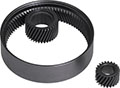
As a high-tech coatings company on the leading edge of thin-film technology, at Richter Precision, we are the only company offering a revolutionary new process called dynamic compound deposition (DCD) coating. Part of our tribological coating services, DCD coatings develop micro and macro-structures that withstand severe contact loading, making these coatings an ideal solution for anti-friction, slide-wear, and high-load applications. DCD coatings are compatible with an extensive range of substrates, including all metals and most ceramics and plastics.
We offer DCD coatings with various compositions. Applied with an average film thickness in the 0.5-1.0 µm range, DCD coatings exhibit a coefficient of friction down to 0.1. They form a robust mechanochemical bond to the substrate, there is no excessive build-up around sharp edges, and they are suitable for use on parts with tolerances down to ±.0001 inch. No post-coating heat treatment is necessary to maintain core hardness and the coating generally preserves the existing surface finish with a slight matte effect possible.
We have successfully used DCD coatings in combination with PVD and CVD coating compositions to address the severe contact loading associated with stamping and forming. PVD and CVD coatings have a surface morphology compatible with DCD deposition, so pairing the two creates a wear and abrasion protection base topped by an extremely low coefficient of friction DCD dry-film lubricant layer. This potent combination dramatically improves tool life and performance in most stamping and forming applications.
Contact us directly to learn more about the features and benefits of our powerful new DCD coating technology and its suitability for your application.
